

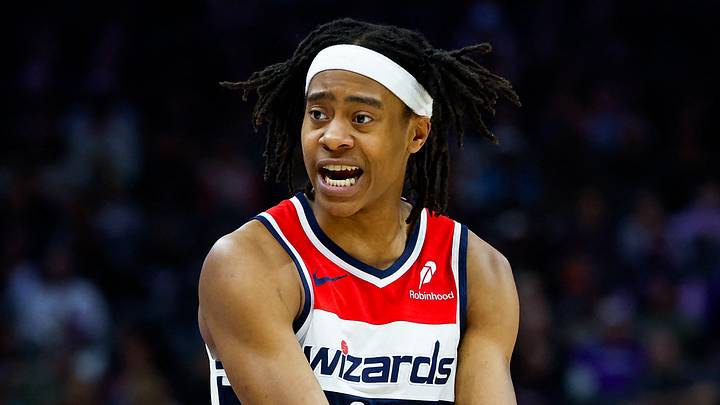
Entering this season, expectations were high for second-year guard Tre Johnson. He has certainly not lived up to them for the Washington Wizards.
Johnson’s rookie year with the Washington Wizards was a roller coaster, as he struggled on a floundering lottery team. However, there were flashes of the efficient scorer many hoped he’d become pre-draft: his 47-44-95 shooting splits across December 2025 gave reason for optimism.
So far this season, we’ve seen glimpses of that player. But just like during his rookie year, Johnson has been incredibly inconsistent. He’s averaging just 8.4 points per game while shooting 37 percent from the field, including 26.7 percent from three, signaling a regression from a season ago.
Washington has largely been able to succeed without their young star, surpassing expectations on defense and thriving on offense. Reaching their true ceiling, though, will depend on youth like Johnson reaching expectations. As they strive to reach new heights, Washington needs more from last year’s first-round pick.
Johnson is struggling to fit in on offense
Last season, Johnson’s role in the Washington offense was quite clear: serve as an offensive engine.
The young player generally functioned with the ball in his hands, serving as the starting point guard. This season, though, with Trae Young in the mix, he has shifted into a secondary role, with most of his shots as the primary creator coming from the bench unit.
The shift in role has led to a serious decline in efficiency for Johnson. Over his last three games, he’s shooting just 20 percent from range and 45 percent from the field.
There’s a chance the guard is simply dealing with a shooting slump, but the quality of the shots he’s taking serves as a worrying sign as well. A large portion of his looks are deep threes and inefficient mid-range jumpers, shots with little chance of seeing the bottom of the net.
It’ll be important for Johnson to find his shooting touch down the stretch. But he also must rediscover his abilities as a driver. The Texas product is failing to take advantage of his speed in the half court, with just 10 percent of his overall shot diet coming around the rim.
If he can improve as a driver, the Wizards guard will likely see easier opportunities from beyond as well, making it easier for him to return to form. Per NBA stat tracking, 12 percent of his threes this season have been tight/contested, while that number was just 6.4 percent a year ago.
By tapping into new strengths, Johnson can become a more useful player for Washington’s offense and tap into his exciting potential.
The guard’s defense still makes him a liability
Even the most optimistic Tre Johnson fans hardly expected him to be a great defender. Johnson’s size at 190 pounds has always made him a serious liability on this end. And asking him to put on more bulk could be potentially dangerous to his biggest strength: his quickness.
The hope for Johnson, however, was that his IQ on defense would improve. The young guard has a tendency to overhelp and get lost off the ball, leading to easy scores for the opposing team. In games against the Magic and Hawks, he was consistently attacked when on the floor.
The Wizards need Johnson to be more active off the ball to mitigate concerns about playing him alongside Trae Young. Young also serves as a real liability defensively, giving teams two players to easily attack in actions.
It hasn’t all been bad for Johnson, nevertheless. On-ball, there are signs of the player taking steps to improve.
According to the basketball tracking website NBARPM, opponents shot 3 percent better per 100 possessions when Johnson was contesting their shots last season, versus when they shot wide-open. This season, they are shooting 4.9 percent worse when Johnson contests.
If Johnson can combine that greater intensity on-ball, with greater instincts off of it, he will become a much easier fit into the Wizards’ rotation. If he can limit his weaknesses, Washington can hope to take advantage of his usual strength: his offense.
 Add us as a preferred source on Google