

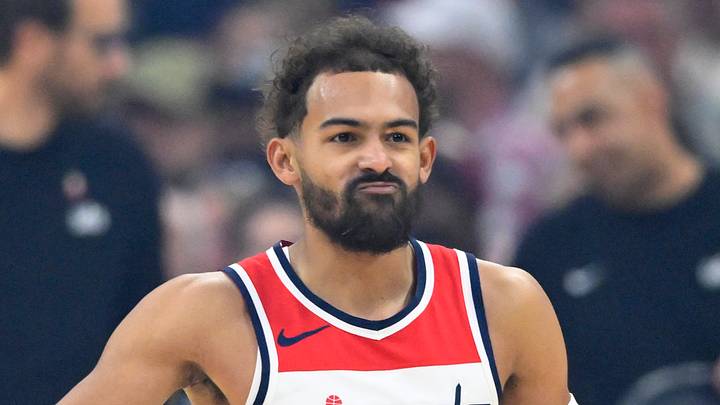
After yet another poor performance against Indiana, Trae Young’s stock seemed to be at an all-time low. And yet, he responded with his best performance in the red, white, and blue. The Washington Wizards guard finished with 37 points and 14 assists in a clash with the Detroit Pistons. Although it wasn’t a perfect game for him, he showed flashes of the role Washington had hoped he’d take on: an organizing force for the entire offense.
Young’s inefficiencies as a shooter have drawn the ire of Wizards fans all year, dragging down an otherwise potent unit. And even as a distributor, the star guard has seemed to have lost a step. Yet, if Young can continue to build on his strong play against Detroit, he can live up to the high standard set for him in the pre-season.
Young is beginning to play more off-ball
On paper, when it comes to Young’s shooting splits, it looks like a typical night for the guard. He finished a rather poor 8-of-23 from the field, including 0-of-7 in the overtime periods.
Even if his shot wasn’t following, though, there were flashes of improvement from Young.
A large issue with the guard’s role early in the year has been the amount of time he’s been on-ball. A player who spends as much time orchestrating the offense as Young does, simply can’t be as turnover-prone and inefficient as he has been.
On Thursday night, Young actually touched the ball more than usual, with 97 touches compared to his season average of 74.5. But many of those touches came without him being the primary creator.
At multiple points throughout the game, the offense flowed through Anthony Davis (78 touches), with Young operating off the catch. In those scenarios, the guard showed some ability to shoot off the catch and function well on handoffs with Davis.
As the de facto point guard for the long term, it’s unlikely that the star guard’s on-ball touches will completely disappear. But by showcasing some versatility, it’ll become easier for him to break down the defense.
The easiest way to counteract Young's career shooting lows, especially from distance(31.5 percent from 3-point range), is to find ways to create more open shots for the star. From the improved passing of Kyshawn George to the skills of Davis as an offensive hub, Washington has the tools to do so.
By shifting Young’s on-ball presence, Washington can best maximize their star’s talents.
The guard must limit turnovers
Even when he’s been more efficient as a shooter, a huge problem for Young and the Wizards' offense has been turnovers.
Washington’s offense ranks in the middle of the league in terms of turnovers per game (15th), but their starting lineup specifically ranks 22nd. Young himself ranks 24th in the league in turnovers per game, at 3.2.
The Wizards’ guard still finished with four turnovers on Thursday night, far from ideal. But overall, he looked more comfortable in the half-court and often made the right pass. He finished the game with 35 points created by assists, leading the entire NBA that night.
Washington’s fast style of play in transition will likely always lead to some turnover woes. However, there are elements that the team could clearly improve upon.
A large percentage of the team’s turnovers come from the pick-and-roll ball-handler (18 percent of pick-and-roll actions) coughing up the ball, a result of Young and other guards making the wrong read in these half-court actions.
If Young can keep the ball moving well in the half-court, Washington can reach their ceiling on offense. His connection with pick-and-roll partners like Davis and Sarr will be essential to maintaining possessions and not unnecessarily giving away points.
By maintaining his composure in half-court situations, Young can help the Wizards limit mistakes, and win the possession battle.
 Add us as a preferred source on Google