

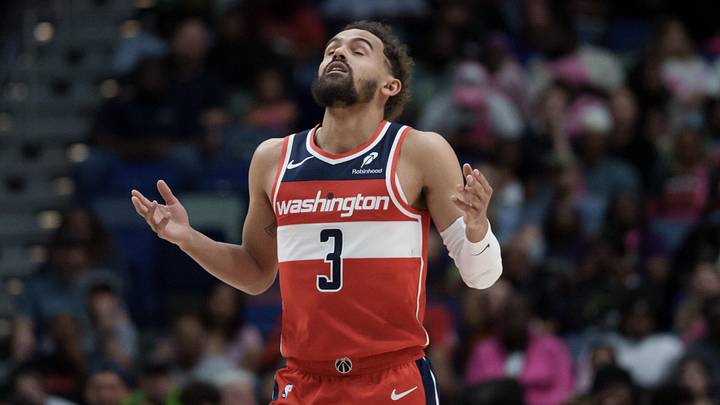
The past week for Wizards fans has been a full-scale celebration.
After one of the worst seasons in NBA history, Washington selected BYU’s A.J Dybansta on Tuesday night to the loud cheers of the fans in attendance. The wing has the chance to be a star, finally giving a lost franchise hope.
Dybansta’s selection should be enough to feel optimistic about the team’s future. Nevertheless, a move made just a day before threatens that positivity.
Washington signed guard Trae Young to a four-year, $212 million contract extension, locking him in for the next 4 seasons.
The decision to resign Young was largely expected, especially after giving up a first-round-pick for him. But pundits and fans alike struggled to understand the decision to pay the guard such a large figure.
Even in the midst of a week of jubilation, the Wizards may have given themselves a long-term headache, one with no easy solution.
Young’s contract guarantees a dangerous long term commitment
When Washington acquired Young back in January, a large part of the excitement was his ability to help the team’s young stars develop. The star’s presence would take some load off guards Tre Johnson and Bub Carrington, allowing them to grow as playmakers.
The addition of the former all-star certainly aided Johnson and Carrington. In the 5 games he started, the offense looked more in sync, led by a proven playmaker in the half-court. But by signing Young long-term, the Wizards risk stunting their young players’ growth.
Carrington and Johnson are unlikely to receive full rein of the offense while Young is starting, given his heliocentric style of play. This means for 4 years, both players could be relegated to roles as off-ball scorers, far from what you drafted them for.
If Young could improve his game to work more off-ball, there's potential for him to fit. But in his 8 years in the league, the guard has rarely shown any ability to do so. His 3-point shooting has slipped in recent years, especially as a catch-and-shoot player, and his effort wanes as a cutter.
While a promising investment in the short-term, four years of Young could weigh heavily on an organization seeking to build for the future.
Young’s salary is a serious overpay
While limiting Johnson and Carrington’s impact long-term could be an issue, it’s possible it may be a risk the Wizards are willing to take. Neither player has shown many elite flashes, and there may be a push to be more competitive now, with the new NBA tanking rules.
However, one piece of Young’s deal that will undeniably have a negative impact is his salary. The star is set to make $47 million next year, $51 million in 27-28, and $54 million in 28-29, with a $58 million player option in 2030.
At the moment, the Wizards don’t have any long-term deals on the books, making Young’s contract easy to manage. But as their stars get older, the team could face some serious problems.
Alex Sarr and Kyshawn George are due extensions next summer, and many other young pieces won’t be far behind. By attaching themselves to Young, the team has made it exponentially harder to keep their core together.
Perhaps Young’s game will reach new heights in 2026, making Washington’s gamble worth it. But at the moment, it looks like a burden for years to come.
 Add us as a preferred source on Google